
PEARL OF SOUND · RAMAYAN REMEMBERED
Thank you for reading this post, don't forget to subscribe!Some songs remind us of a show. Others remind us of home.
From Ramayan to Shri Krishna: familiar voices, new questions, and the music we choose to carry forward.
Can Ramayan 1987 songs move you even if you have no childhood memories of them? That is a more useful question than simply declaring the old music timeless. For one listener, Ravindra Jain’s voice brings back a family living room. For another, the same song is unfamiliar: the words need explaining, the scene needs context, and its emotional pull has to be discovered.
This guide brings those listeners together. Revisit the songs, find authorised recordings, understand their credits and explore how Ramayan and Shri Krishna can open conversations about love, responsibility, separation and devotion. You do not need to share someone else’s memories to find a reason to listen.
A cultural music essay: documented production and recording details are linked to their sources; emotional readings are offered as interpretations.
Why Can Shri Rama’s Name Feel So Personal?
For a devotee, Shri Rama can be approached as an eternal divine presence: someone addressed in prayer, remembered in difficulty and honoured through conduct. “Eternal” expresses that faith relationship here. It does not predict that any particular film recording will become an immortal classic.
Someone approaching the Ramayana through literature or performance may begin elsewhere—with its relationships, choices and emotional conflicts. Both readers can find questions worth considering. What does keeping a promise demand? How should strength be used? What remains of love when circumstances change?
In this essay’s reading, soulful music offers space for those questions. Repeating a name may suggest reassurance. A quiet phrase may suggest tenderness. A forceful passage may suggest determination. None automatically carries the same meaning for every person, and volume alone cannot measure spiritual depth.
How Has Ramayana Storytelling Lived Through Music?
The relationship between the epic and performance is documented cultural heritage. UNESCO describes Ramlila as a performance combining song, narration, recital and dialogue, and connects the northern Indian tradition with Tulsidas’s sixteenth-century Ramacharitmanas. The tradition was inscribed on UNESCO’s Representative List in 2008, following proclamation in 2005.
This provides a concrete cultural connection across generations. It does not establish dates for events narrated in the epic. A living tradition, a religious conviction and an independently verified historical claim answer different questions; an article gains clarity by keeping them distinct.
For more listening context, explore our Hum Katha Sunate Hain guide or our discussion of Ramayan music across adaptations.
How Did Ravindra Jain’s Music Tell the Ramayan Story?
The production listing for Ramayan credits Ravindra Jain for music. But a composer credit alone does not explain why a voice stays with a viewer. To explore that, we need to consider what the singing does within the story.
An academic study of music and sound in Ramayan and Mahabharat describes Jain’s singing narration as a way of accompanying actions and expressing characters’ feelings. This gives the music a storytelling function as well as a devotional one. The discussion below builds on that distinction; it is not a claim that we have independently analysed every episode.
For a listener, such a voice may become a familiar guide. An emotional scene is remembered with the way it was sung, not only with its dialogue. That is this article’s reading of why revisiting the music can bring the story—and the people beside whom it was watched—close again.
Which Ramayan Songs Should You Start With?
| Song or refrain | Verified listing | An emotional question to bring to it |
|---|---|---|
| Sita Ram Charit Ati Pavan | Tilak’s upload is explicitly labelled remastered; it is not presented here as an untouched broadcast master | What changes in our attention when a story is introduced through devotion? |
| Ram Kahani Suno Re Ram Kahani | Tilak credits Ravindra Jain for singing, words and music, and identifies the Hanuman–Sita scene | Can a familiar story become reassurance when someone feels alone? |
| Hum Katha Sunate Ram Sakal Gun Dham Ki | The licensed YouTube listing identifies Uttar Ramayan – Pt. 10; vocals by Ravindra Jain, Kavita Krishnamurthy and Hemlata | What happens when a younger voice carries a story forward? |
| Mangal Bhavan Amangal Hari | This Tilak entry is a later devotional release, with music credited to Ravindra Jain | Does recognition begin with the tune, the words or a personal memory? |
These entries are a listening selection, not a definitive 1987 episode soundtrack. Original Ramayan, Uttar Ramayan, later devotional releases and remasters should not be collapsed into a single album. Channel upload dates also do not establish when the underlying compositions were first created.
Sita Ram Charit Ati Pavan: Returning to a Familiar World
Our interpretive starting point is the feeling of entering a story with reverence. A familiar invocation can shift attention away from the rush of the day and towards the characters and their choices. For someone with childhood associations, that transition may also recall a particular room, television or family routine.
A younger listener may have none of those memories. Their first connection could be someone explaining why the refrain matters. The same recording can therefore hold an old association for one person and the beginning of a new one for another.
Ram Kahani Suno Re Ram Kahani: A Story as Reassurance
Tilak’s description places the song in the scene where Hanuman introduces himself to a distressed Sita in Ashok Vatika through his account of Rama. RJ Group’s verified-channel release also credits Jain as composer, writer and singer.
The emotional reading is especially personal: a story can do more than provide information. It can establish recognition and trust. To a person waiting in uncertainty, hearing about someone they love may offer a reason to hope.
This does not make everyday loneliness equivalent to Sita’s circumstances. It helps a listener identify an emotional question within the scene: what words would make me feel remembered rather than forgotten?
Hum Katha Sunate: A Story Carried by Younger Voices
The licensed recording’s description credits Jain as composer and author, alongside the three listed vocalists. It belongs to the Uttar Ramayan listing, so it should not casually be called the opening song of the original 1987 series.
Read through the theme of this article, a story being sung onwards provides an apt image of a connection between generations. A younger listener does not have to reproduce an older listener’s memories. They can understand the words, ask their own questions and eventually decide what they want to carry forward.
Mangal Bhavan Amangal Hari: The Memory Around the Music
A refrain may be associated with prayer, family or a later discovery. Our reading leaves room for all three. Its meaning for a particular listener may depend as much on when and with whom it was heard as on its place in a television story.
To listen carefully, begin with the linked version’s actual credits. Then consider the words, performance and context. Familiar devotional phrases can appear across multiple recordings; recognising the words alone is not enough to identify the exact version.
From Ramayan to Shri Krishna: What Changes When We Listen?
The connection extends beyond one television serial. Sagar World’s account of Shri Krishna dates its first Doordarshan telecast to 1993, identifies Swapnil Joshi and Sarvadaman D. Banerjee as the younger and adult Krishna, and describes its journey from childhood stories to the Bhagavad Gita. It also records a 2020 lockdown rerun.
That range offers a useful listening question. How does music invite us to approach the divine—as a child to be cared for, someone dearly missed, a protector or a guide? Rather than assigning one emotion to Rama and another to Krishna, listen to the particular scene and relationship. Tenderness, longing and duty need not belong to only one story.
A Krishna Listening Entry With Clear Credits
For a recording you can check, try Tilak’s Shri Krishna Govind Hare Murari 2. The upload credits Ravindra Jain and accompanying singers for vocals, and Jain for lyrics and music. It is explicitly labelled remastered; its description discusses digital enhancement of sound and visuals. It is recommended here as a credited Krishna devotional recording, rather than certified as an untouched soundtrack from a particular original episode.
Begin with the address to Krishna in the title. What does returning to those names invite you to do: remember, pray, concentrate or simply listen? A devotee may approach the refrain as worship; a newcomer can begin by learning who is being addressed. Neither response needs an invented childhood memory.
| Listening entry | Context to check | Question for a first-time listener |
|---|---|---|
| Ram Kahani Suno Re Ram Kahani | Hanuman’s account of Rama to Sita; linked credits above | How can telling someone a familiar story establish trust? |
| Shri Krishna Govind Hare Murari 2 | Tilak’s credited, remastered devotional upload | How does repeating a divine name shape your attention? |
Familiar titles can lead to different performances. Check the serial, singer and release separately: a Krishna bhajan appearing on the same channel as a television series is not, by itself, proof that it appeared in that series.
Why Do Arun Govil and the Cast Inspire Such Reverence?
The production’s series description identifies Arun Govil as Rama, Dipika Chikhlia as Sita and Sunil Lahri as Lakshman. For some viewers, these portrayals are closely associated with the sacred figures they grew up imagining.
That connection can extend beyond a performance. In an October 2022 report, Arun Govil discussed an emotional encounter with a woman who bowed before him at an airport. He understood such gestures as expressions of belief and faith, with himself serving as a symbol.
A viewer may know they are looking at Arun Govil, yet experience the familiar portrayal as a reminder of Shri Rama. That response can express devotion while recognising the distinction between the performer and the sacred figure he portrays.
Music offers one way to explore this association. A face remembered with a voice, a prayer or a scene may carry more personal meaning than a face seen alone. This is our interpretation of the connection, not a measured explanation of why every fan responds.
For someone who feels this attachment, the performance may seem “real” in the sense of emotionally convincing and spiritually close. Here, that word describes the viewer’s experience. It does not certify a television image as a historically exact portrait.
What Do Ramayan’s Stories Have to Do With Everyday Life?
This comparison offers reflective possibilities, not historical equivalences or audience-survey findings. Versions and adaptations may tell particular episodes differently.
| Narrative motif | Emotional question | Possible everyday connection |
|---|---|---|
| Departure and exile | How do we carry love when we leave? | Moving away from family for work or study |
| Companionship | What makes togetherness meaningful? | Trust and mutual attention in a relationship |
| Separation and waiting | How do we live with longing? | Missing someone when reunion is uncertain |
| Hanuman’s service | How can devotion become action? | Helping through effort, not words alone |
| Return and reunion | What does home mean after difficulty? | Belonging, gratitude and reconciliation |
How Did the 2020 Lockdown Bring Ramayan Back to Family Viewing?
The pandemic reruns gave this intergenerational connection a documented setting. A 2 April 2020 Press Information Bureau release confirms the return of Ramayan and Mahabharat from 28 March, on DD National and DD Bharati respectively. It describes the decision as a response to public demand and a way to engage home-bound audiences.
Prasar Bharati’s 2020–21 annual report also records Vishnupuran among the programmes sourced during lockdown. These records establish the programming context. They do not measure how much knowledge each viewer gained.
| Programme | Documented context | A possible discussion prompt |
|---|---|---|
| Ramayan | 2020 rerun on DD National | What does responsibility ask of someone? |
| Mahabharat | 2020 rerun on DD Bharati | How should we think about a difficult moral choice? |
| Vishnu Puran | Included in Prasar Bharati’s lockdown programming record | What is an adaptation showing, and where can we read further? |
The prompts are editorial suggestions, not measured educational outcomes. A family might use a scene to discuss a character, explain a word or compare a remembered episode with what appears on screen. In that sense, watching can become a beginning for learning rather than its endpoint.
Music matters to this possibility because the refrain may remain after the discussion ends. A younger listener might later ask what the words mean; an older relative might explain why a scene mattered to them. That is the connection this article explores: a programme becoming an occasion to listen to one another.
Learning also includes asking questions. A television adaptation is an interpretation of a tradition, not a replacement for the text or proof that every depicted detail is historically verified. Curiosity can deepen engagement without requiring every generation to respond identically.
How Can Gen Z Connect With Ramayan 1987 Songs?
A young person cannot remember watching in 1987 if they were not yet born. Their connection may instead begin through a parent, a grandparent, a later television broadcast or their own discovery. That distinction makes the connection more interesting: the memory can be shared before it becomes personal.
There are documented examples. Mint’s April 2020 reporting described younger viewers discovering the rerun through family. It included a 16-year-old who watched with her parents and recommended the series to friends. This demonstrates one route into the programme; it does not establish the preferences of an entire generation today.
What If You Have No Childhood Memory of Ramayan?
Nostalgia cannot do all the work. A first-time listener deserves an answer to “Why should I hear this?” that goes beyond “our parents loved it.” Begin with a scene: a person waits, a messenger arrives, and a song helps establish recognition. You can ask what the words communicate and how the performance serves that moment.
Nor is this a contest between an emotional older generation and a logical younger one. A useful conversation leaves both room to feel and room to question. Ask an older viewer about a character’s difficult decision; ask a younger listener which phrase stayed with them. The answers may surprise both.
Where Might the Music Feel Difficult Today?
Consider these as listening questions rather than verdicts from an audience survey. Unfamiliar vocabulary may make the meaning hard to follow. A long passage may feel demanding without its scene. Repetition may feel absorbing to one person and slow to another. Childhood affection can also make it difficult to explain what a newcomer should notice.
The response is context: explain a few words, identify the speaker and offer a complete authorised recording so the listener can explore at their own pace. A brief introduction can open the door without insisting on a particular emotional reaction.
For Our Parents, It Was a Memory. For Us, It Became One.
Perhaps the longing is not only for a programme. It may also be for someone who watched it beside us. That is an editorial possibility, not a description of every household.
PTI’s reporting on the 2020 return recorded memories of family and neighbourhood viewing, including one viewer recalling watching with his mother and brothers. Such accounts make the nostalgia concrete: a person can be remembered through the occasion as well as the story.
An older relative might hear the music and remember the first broadcast. A younger person might remember watching the rerun with that relative. Both associations can matter, even though they began decades apart.
Try asking someone who watched the original broadcast: which song do you remember, and who watched it with you? Then describe your own first encounter. The difference between the answers can be the beginning of a conversation, rather than a disagreement about which generation understands the story better.
Can Young Viewers Ask Questions and Still Feel Connected?
Younger viewers may also ask difficult questions about a character’s choices, relationships or portrayal. The same Mint report included critical discussion alongside family viewing. Curiosity should not automatically be treated as rejection of the story.
A welcoming introduction would invite a younger listener to watch, understand the words, ask questions and describe their own response. Declaring that all Gen Z viewers are disconnected—or that they all feel devotion—would flatten very different experiences into a slogan.
Can We Love the Old Ramayan Without Dismissing Everything New?
Affection does not have to become a competition. A viewer can treasure Arun Govil’s portrayal and Jain’s music while allowing another adaptation to make its own choices. Nostalgia explains a personal bond; it does not automatically settle every artistic comparison.
It also helps to distinguish emotional familiarity from historical exactness. A performance may feel profoundly convincing to a devotee without being evidence that every visual detail reproduces the past.
A rewarding comparison asks specific questions: how do voice and image work together, how clearly do the words communicate, and what does a scene invite us to feel? These questions respect the original experience while leaving room for thought.
Can This Music Reach Listeners Outside India?
The practical starting point is understanding, not asking a listener to arrive with a particular faith. An English introduction can name the characters, explain the situation and paraphrase a short passage’s meaning. Transliteration helps someone follow the sounds; a translation helps them consider what the words say. Both should be checked rather than improvised as literal lyrics.
For someone accustomed to Hollywood storytelling, begin with a recognisable dramatic situation: separation, an unexpected message, a reunion or a difficult promise. Then explain what is specific to this devotional tradition. An accessible introduction should preserve that identity rather than turn every sacred reference into a generic feeling.
There is no single “foreign taste,” just as there is no single Indian response. A listener may come for the voice, the story, a family connection or religious interest. Translated context and reliable access are ways to welcome them; they do not guarantee international popularity.
Can Colourful Sets and VFX Create the Same Connection?
A useful adaptation comparison asks what image and music accomplish together. Do the visuals clarify the scene? Can you follow the words? Does the performance give the characters space to feel? Spectacle can support a moment, but its scale alone cannot tell us whether the music communicates.
Equally, familiar older visuals do not make a performance automatically superior. A contemporary production can earn its own connection through clear storytelling, thoughtful musical choices and performances that invite attention. The rewarding question is what survives after the spectacle: a lyric’s meaning, a character’s choice or a feeling you want to revisit.
For the film adaptation, explore our Ramayana Part 1 music guide. To continue the comparison with television, read our guide to music across Ramayan adaptations. This article centres on the older television tradition; each adaptation and recording deserves its own context.
Where Can You Listen, and How Do You Choose the Right Version?
A Simple Listening Guide for First-Time Viewers
- Choose a song from the table. Start with “Ram Kahani Suno Re Ram Kahani” if you want a specific story scene, or a familiar refrain if you are exploring devotional listening.
- Check the upload before pressing Play. Read the channel name, song title, singer credits and whether it says original, remastered or a later collection.
- Understand the setting. Ask who is speaking or singing, who is being addressed, and what has happened in the story.
- Listen once without multitasking. Notice the words you recognise and the feeling you take from the passage. Replay only the part you want to understand better.
- Compare memories, not ratings. Ask a parent or grandparent what the same passage recalls for them. A first-time listener can offer a different response without either person being wrong.
If your goal is the exact television scene, follow the production’s episode information instead of assuming that a compilation, cover or remaster preserves the original broadcast audio.
Start with Tilak’s “Mangal Bhavan Amangal Hari” audio jukebox, whose description lists Ravindra Jain’s credits and chapter times. It is labelled as a later devotional collection; its upload date should not be confused with the original television broadcast.
If the embedded player is unavailable, open the authorised channel upload. For episode information, visit the production’s Ramayan page.
Ramayan Songs: Singers, Versions and Listening Questions
Who composed the music for Ramanand Sagar’s Ramayan?
Sagar World’s production listing credits Ravindra Jain for music. Check individual releases for the singers and recording-specific credits; the series music credit does not mean he performed every vocal part.
Who sang Ram Kahani Suno Re Ram Kahani?
Tilak’s recording description credits Ravindra Jain for vocals, lyrics and music. It identifies the scene in which Hanuman tells Sita about Rama in Ashok Vatika.
Who are the singers of Hum Katha Sunate Ram Sakal Gun Dham Ki?
The licensed recording linked here lists Ravindra Jain, Kavita Krishnamurthy and Hemlata as vocalists, and Jain as composer and author. Other recordings may have different credits.
Is Hum Katha Sunate from the original Ramayan or Uttar Ramayan?
The linked licensed release identifies it under Uttar Ramayan – Pt. 10. It should not be described as the opening song of the original 1987 series. Its digital upload date is not proof of the composition’s first release date.
Where can I find old Ramayan songs in the same voice I remember?
Use the authorised entries in the song table, then compare the stated singer and version. A similar title may lead to a cover, remaster or later devotional recording. For an exact scene, use the production’s episode listing and compare the performance rather than relying on the title alone.
Does a remastered upload contain unchanged original audio?
Not necessarily. Tilak labels the Sita Ram Charit upload as remastered and describes digital enhancement. That label should remain visible when recommending it; improved clarity and an untouched broadcast master are different claims.
Why might Gen Z connect with Ramayan 1987 songs?
Family viewing and later reruns can introduce the music to younger listeners. Reporting from 2020 includes such examples, but does not establish that all younger viewers share the same taste or devotional response.
Why do some viewers bow before Arun Govil?
In a reported account of a fan encounter, Govil understood the gesture as an expression of faith, with himself serving as a symbol. This describes that account, not every viewer’s behaviour or belief.
Which Song Would You Pass On—and Why?
The most personal question may be: which feeling do you recognise, and what does it ask of you?
A prayer may invite trust. A love song may invite attention. A forceful passage may invite reflection on strength. The recording offers a starting point; the meaning you consider belongs to your own listening.
Did you discover Ramayan or Shri Krishna through family, a rerun or your own curiosity? Tell us one song you would recommend, what it means to you, or one question you still have. First-time listeners are welcome too.
Share your memory in the comments, or share this article with someone you watched it with.
Keep exploring: the meaning and credits of Hum Katha Sunate Hain, or music and storytelling across Ramayan adaptations.
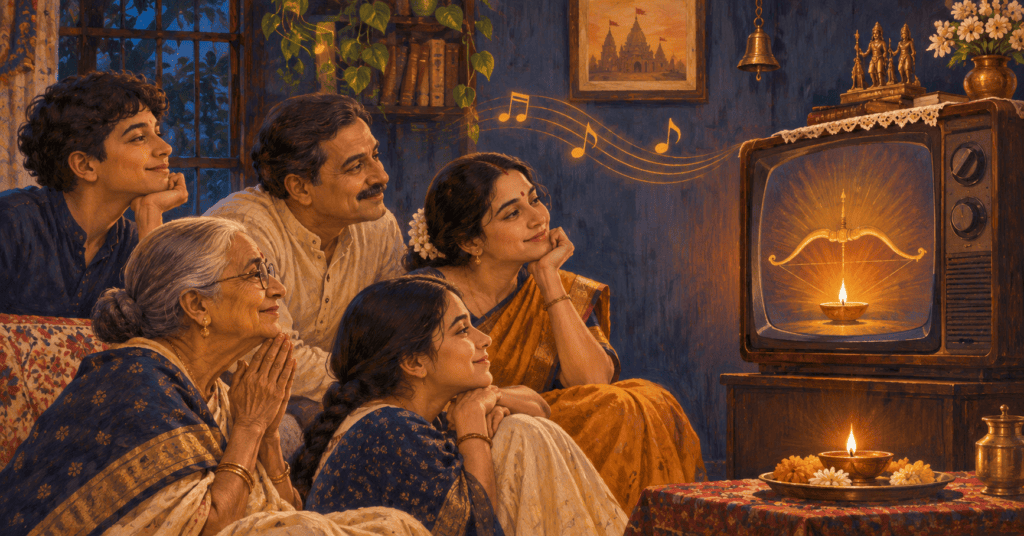
Featured image: original AI-generated editorial illustration of family viewing, not an archival photograph.